In the warbling red light, locks, lights, out of sight, an English class huddles in the corner of a white-walled classroom.
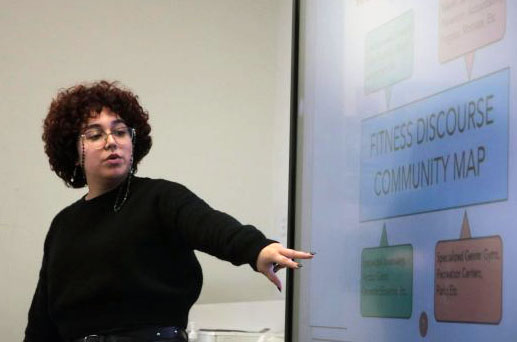
Recent Texas State University graduate and English II teacher Paola Contreras stepped into the roll vacated by Matt Hoadley on Jan. 6. In between getting-to-know you activities and Measure of Academic Progress testing, Contreras’ first week witnessed a bomb threat to solidify the closeness of students and their new teacher.
“It was insane,” Contreras said. “That is not something that I ever would’ve believed would happen during my first week of teaching. We are all trauma bonded now. I’m still learning names, but in that room, I already know everyone.”
Contreras began her education journey with her sights set on mathematics and robotic engineering. By her graduation on Dec. 3, Contreras shifted her major to English and Education.
“Life changes,” Contreras said. “I’ve always been into coding but as soon as we learned the different dimensions and I was like, ‘you know what? I’m good. I don’t wanna do math.’ Then I thought ‘I’ll go into English. I like to read. And I enjoy analyzing what I read, so might as well make a career out of it.’ It was always going to be teaching. It was just the question of what subject.”
For aspiring teachers, Texas State University provides a job fair, inviting graduating students to meet with nearby districts about possible job offers.
“I got very, very lucky,” Contreras said. “We got to sell ourselves. That’s where I started talking to the recruiting team of Leander. I am a yapper– I just talked and talked and talked with them. That’s how I got in contact with the principal and with the assistant principals. And from there, it just evolved into, interviews and more interviews. It was surreal. Your administration and your team can make it or break it when it comes to teaching. You can either be very miserable or you can be very happy. For me, the vibe was there.”
Contreras said she’s had to “play catch up,” with all of the lessons and grading leftover by a period of substitute teachers.
“I’m trying my best and I’m working with the students,” Contreras said. “I’m trying to honor the deal with their teacher that they had before. It’s a little difficult because my advanced students have had substitutes since October. They were graded on their learning, so I’m just trying to play catch up. My students are troopers.”
Students have also adjusted to the semester transition, expressing more of an affinity for Contreras as she’s so close in age.
“I really like my new teacher,” sophomore Reagan Crum said. “I feel like she can relate to us and match our energy more compared to other teachers because of how young she is. I really like her energy and I like how we have some not the same interests too like the ‘Avatar’ movies and a love for reading.”
Despite participating in education classes the Texas Association of Future Educators throughout high school and college, Contreras said she was still nervous to adopt the position.
“I still get nervous,” Contreras said. “Even though I have the experience, it still freaks me out. On Monday [as students came in], my heart was thumping so fast. I kept telling myself ‘you know your stuff, you’ve been studying for this, you’ve been training for this moment.’ It really is a great help that all of my students are like so nice.”
To ease the transition process, fellow English teacher Emily Huffman was assigned to mentor Contreras, a program practiced district-wide.
“When you’re a new teacher there’s a lot of information you’re expected to learn very quickly,” Huffman said. “Especially as a first year teacher, if you’ve not done the job before, then it’s often isolating if you don’t have somebody to kind of show you the ropes. The nice thing is that we teach the same classes, so we’re able to talk about that together as we plan lessons. It’s also informal– I’ll check in and make sure that she understands [everything] and she’ll pop in and ask me questions too.”
Starting mid-year, Contreras admitted the process has been a “trial by fire.”
“I look forward to actually catching up,” Contreras said. “Because I came in the middle of the year, everything’s everywhere. I get no training, I am just thrown in the deep end, but I know I will learn as I go. I look forward to the moment when I can say ‘I do know the answer to this question.’ That is that is the thing that keeps me going. There’s a bit of a learning curve, but my students have been taking [the transition and my teaching] pretty well. All of my students are so nice.”