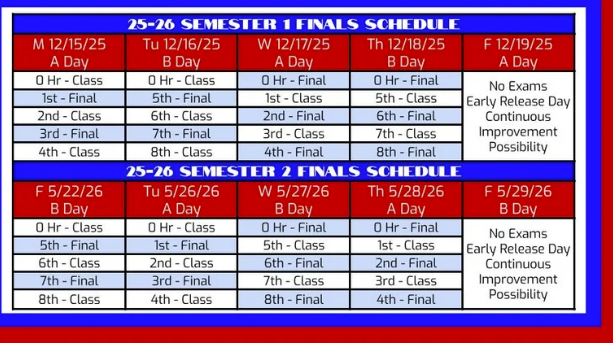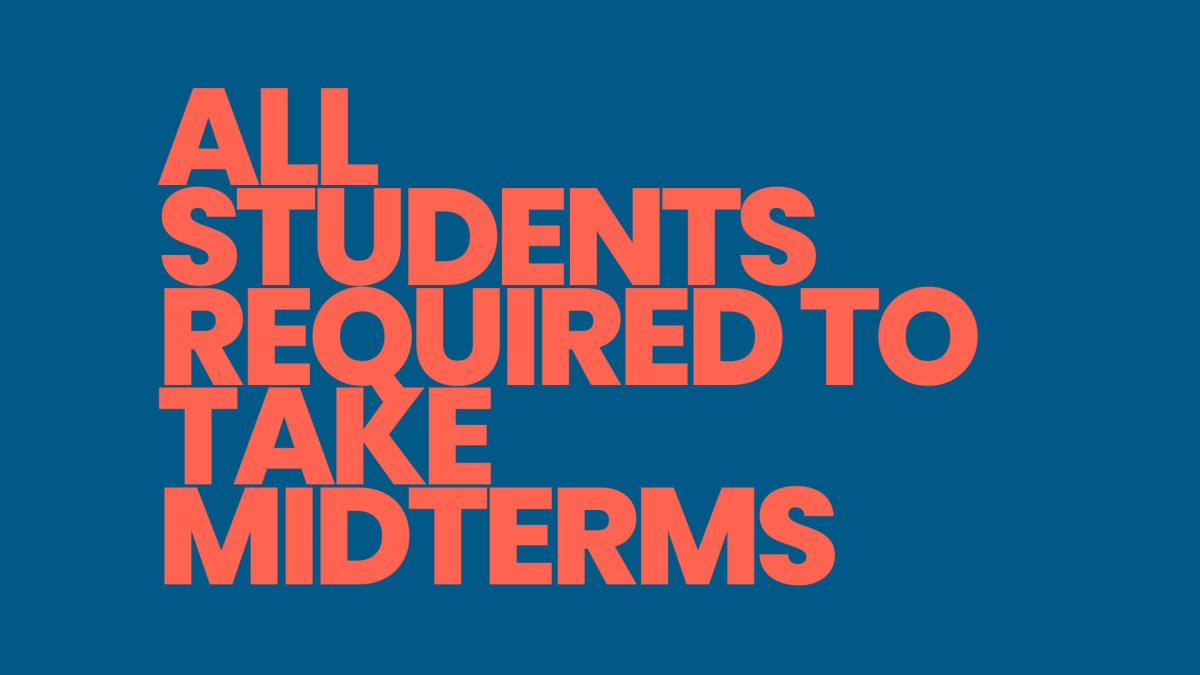
After the school board and department heads voted to reinstate midterms, all students will take final semester exams.
“I know we stopped [doing midterms] for a little while and we did get some pushback from campuses because it was a snapshot for them to see [students’ progress],” Board of Trustees president, Anna Smith said. “[Now] we’ve seen some pushbacks from students. ‘This is just another exam we have to do, another week we have to get ready for it.’ Students are already overwhelmed and overworked and over-tested. We’re trying to figure out that happy medium.”
Winter exams are only considered finals for semester class. Social studies Department Chair and AP psychology teacher Sabrina Sozansky attributes students’ response to finals to the name itself.
“My problem with the whole thing is that the school should have never, in first place, called these finals,” Sozansky said. “They’re midterms. There’re only four or five classes that are semester classes on campus the entire year. Those classes are exempt from this final, because that is literally their final exam. They have their own policy. There are growing pains now. Processing [midterms] now is the hard part.”
LHS was the only school in the district to offer exemptions last year.
“If our goal is to prepare students for a college, for a career or for military, at the end of the day, there’re very little exemptions that occur in adult life,” Sonzansky said. “Without midterms, we are not putting our students at a competitive advantage. We were the only school in the district last year that exempted winter exams. That didn’t sit right with me because if Vista Ridge can be the number one school in the district academically, and they don’t exempt midterms, then we need to be stepping it up.”
As the person doing the grading, English teacher Micah Gum said he is “not terribly thrilled” with the required midterms.
“We [teachers] have already processed through all this information and creating another grade just for the sake of a grade doesn’t make sense,” Gum said. “As a teacher, you should be grading as you go along. On the flip side, it is a skill students will need if they want to go on to university or any sort of advanced training, they’re going to need to have the ability to study for and do these things. I don’t like adding extra grades just to make extra work, but I think that it does make some sense.”
For the district, midterms represent a measurement of a student’s mastery of the required Texas Essential Knowledge and Skills set by the State Board of Education. For humanities, this does not translate measure for measure.
“I don’t think [midterms are] as representative as student’s growth, not like looking at their change in grade over a period of time is,” Gum said. “I don’t think that finals add more fidelity to seeing progress in a student. English is not like math like ‘you have to know this in order to be good at that.’ In English, you can be good at great at creative writing and weak in static writing or vice versa. So it’s not really that valuable for [our department].”
Each department chooses its midterm’s format, be that a cumulative test, project or presentation. Students are still required to complete any assignment outside of the exam.
“Students are not given enough time to study, have to balance daily assignments on top of it and aren’t truly taught how to study for such exams,” senior Elizabeth Chaison said. “I understand the elimination of exemptions, but it’s frustrating as a student who has been consistently performing well in each class not to be able to rely on the established exemption policy, especially as a senior who has to balance it all with college applications.”
Still, Honor Society called finals and stress synonymous as they contribute to heightened anxiety in students.
“I worry about the mental toll that it’s taking on students,” Smith said. “I know it’s a shock because we weren’t doing [midterms] for a while, but we’re trying to figure it out. We’re just trying to find out the best way we can to support our students. Hearing for more students is the key because [students] are impacted by this the most.”